


 COMINGComing with onchain gameplay — in development on devnet; dates will be announced.
The technical deep dive: what the game works out each day, what goes on Solana, how the vault is guarded, and how one proof pays every unclaimed day.
On this page
- How it works, in short
- What happens where
- Where the KEEP comes from
- From your day to a number
- The daily result: one fingerprint of everyone's totals
- Publishing a day
- Your claim, step by step
- Your permanent records
- Safety switches
- What you can check yourself
- Before real claims: a practice period
- Still being tuned
- Where it stands
- See also
This is the technical side of KEEP mining: what the game server works out each day, what is published on Solana, how the KEEP that pays for mining is funded and guarded, and how one claim with one proof pays every day you haven't claimed yet. KEEP mining is in development: it works end to end in testing and is not deployed yet.
Onchain gameplay is in development on devnet; dates will be announced. Devnet KEEP, SOL and items have no monetary value, and nothing on this page is a promise of income.
How it works, in short
- The game server does the gameplay maths. After each UTC day closes, it works out every wallet's share from records it has already verified — never from anything a player's app sends.
- An independent check recomputes the whole day before anything is published.
- Solana holds the KEEP and enforces the limits. The mining program accepts a day only if the KEEP for it is already in the mining vault and every limit holds.
- Each day becomes one fingerprint. The result is a single Merkle root over every wallet's running totals, published on Solana.
- One claim pays everything. Your claim proves your running total against the latest result, and the program pays the difference from what you have already claimed.
What happens where
| Step | Game server | Solana |
|---|---|---|
| Your day | Records your committed ingots, finished battles, building history and active bases | — |
| Land Deeds | Reads finalized ownership for the whole day | The Land Deed NFTs themselves |
| Shares | Works out every weight and share in exact whole units | — |
| Checking | An independent check recomputes the full day | — |
| Publishing | Submits the day's result | Accepts it only if the KEEP is already in the vault and every limit holds |
| Claiming | Prepares your claim and your proof | Checks the proof and pays the difference to your wallet |
| Records | — | Your permanent claim record and Renown record |
The rule behind the split: the server decides what happened in the game, and Solana decides what may be paid. Neither can do the other's job.
Where the KEEP comes from
- The mining vault. KEEP for mining will sit in a vault that only the mining program controls. The vault will be funded by plain transfers from a reserve under multisig control.
- Nothing is created on demand. A day can be published only when the vault already holds that day's budget on top of everything already owed for earlier days.
- The day's budget is the smaller of two amounts: the daily ceiling of up to 98,000 KEEP (gross), and what the vault can cover above everything already owed.
- Recycled KEEP funds later days only. The 10% of newly mined KEEP that goes back to future mining, and KEEP paid for Gems, return to the reserve. Neither tops up the day it came from.
From your day to a number
- Only verified records count: committed ingots, sealed battle results, building history, your active bases, Land Deed ownership read from finalized chain data, and the Seeker Island spots that won the term. No request from an app can supply a score, a time or a reward.
- A Land Deed must be yours for the whole day to count that day. Activity always stays credited to the player who did it.
- Battles belong to the day they started. In the version being tested, a battle is recorded on the day its first troops were deployed, and the day's result waits for battles still in progress.
- Nothing is guessed. If a record the day depends on is missing or in conflict, the day waits until it is resolved; nobody's activity is counted as zero by mistake.
- Each pool is worked out on its own. Within the pool without a Land Deed and within the Land Deed pool, your weight is your counted ingots × your score × your boost, and your share is that pool × your weight ÷ the pool's total weight. See How your share is worked out.
- Amounts are exact. Every amount is counted in KEEP's smallest onchain unit. Rounding never creates KEEP: any leftover dust stays in the vault.
The daily result: one fingerprint of everyone's totals
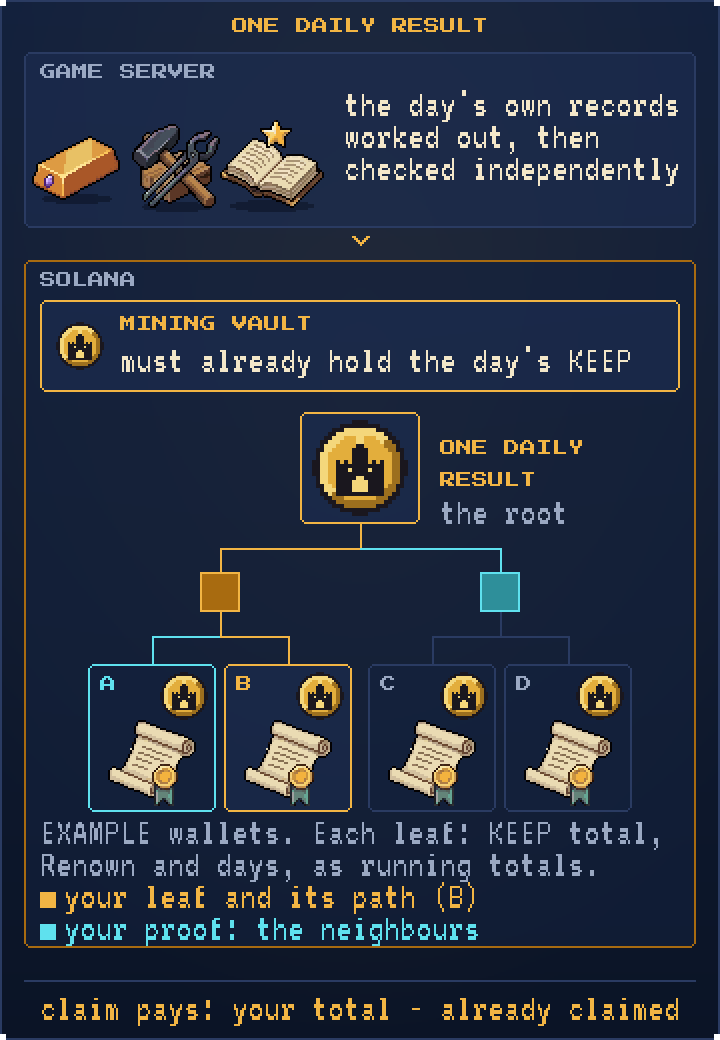
- One leaf per wallet. Each leaf holds that wallet's running totals since mining began: the KEEP allocated to it, its Renown and its mining days.
- A Merkle-sum tree. Leaves are combined in pairs, level by level, until one root is left. Every node also carries the sum of the KEEP below it, so the root commits to the grand total as well as to every leaf.
- One root a day. Only the root — a short fingerprint — goes on Solana, together with the day's totals. Changing any leaf, anywhere, would change the root.
- Your proof is one neighbouring node at each level on the way up — in the picture, leaf A and the C–D node. From your leaf and those neighbours, the mining program rebuilds the path to the root and checks that it matches the published one, without needing everyone else's records. Each neighbour carries its KEEP sum too, so the rebuilt root also confirms the grand total.
Publishing a day
The mining program accepts a day's result only when all of these hold:
- The day has fully closed, and results are published in order: each one carries the next number and is for a later day than the last.
- The gross total is within the ceiling of up to 98,000 KEEP; the pool without a Land Deed is within its 5%, and the Land Deed pool within the rest.
- The vault already holds the day's budget on top of everything already owed.
Before the game submits a day, an independent check recomputes the full old and new sets of totals and confirms that no total goes down and no wallet disappears. The check alone can never publish anything, and the mining program itself does not see it — which is one reason claims also wait for a safety delay.
When a day is published:
- The tax split is applied exactly: 80% to players, 10% to the Seeker Island pool and 10% back to future mining, to the unit. Your leaf already shows your share after tax.
- The recycled share goes back to the reserve straight away.
- The island share is set aside for the Seeker Island spots that won that term, one equal share per winning spot.
- Claims open after a short safety delay, so a mistake can be caught before any KEEP moves.
Your claim, step by step

- Ready to claim. The day's result is published and its safety delay has passed.
- Estimate fees. KEEP mining shows the SOL the claim will cost.
- Approve in your wallet. Review what you will receive first. Your wallet only signs; the game then sends exactly the transaction you signed, with nothing added after you approve.
- KEEP arrives. The mining program checks your proof and pays the difference to your wallet.
- Renown recorded. The same claim updates your Renown record, and KEEP mining shows the confirmed transaction so you can check it.
What the mining program checks on every claim:
- the result you claim against has not been withdrawn;
- its safety delay has passed;
- your proof matches the published root;
- it pays only your total minus what you have already claimed;
- the vault still covers everything owed to everyone else afterwards;
- your Renown and mining days only go up, and at most once for each day.
What it costs:
- No claim fee and no minimum. Allocations never expire.
- The Solana network fee, paid by you, on every claim.
- One-time rent on your first claim for your permanent claim record, your Renown record and, if you don't have one yet, a KEEP token account. Nobody sponsors these costs, and the rent for the two permanent records is never refunded.
- No SOL? KEEP mining shows the top-up you need; your allocation is never lost.
- A failed claim pays no KEEP, but the network fee may still be spent. Prepare it again: saved claims survive an app restart, and nothing retries by itself.
Your permanent records
Your first claim creates two small records on Solana that belong to your wallet, and every one of your bases shares them:
- Your claim record remembers how much KEEP your wallet has claimed in total, so each claim pays only the difference.
- Your Renown record keeps your Renown and your mining days. Your mining claims update it, and anyone can refresh it from a published result without claiming — a refresh moves no KEEP. See Renown and EXP.
Safety switches
- Pause. Publishing and claiming can each be paused.
- Correction. Only the newest result can be withdrawn and replaced, and only while nobody has used it — no claim and no Renown refresh. A corrected result gets a fresh safety delay.
- Funding is never taken back. A corrected result must carry exactly the same funded total as the one it replaces, and a result that has already been used is never changed.
- Surplus has one way out. Spare KEEP in the vault can only go back to the reserve, and never below what is owed.
What you can check yourself
Anyone can read, on Solana:
- each day's funding record, published result and totals;
- the vault's KEEP balance against everything owed;
- the events for every publication, claim and correction.
Every player can also get their own leaf and proof, and check it against the published root. A public transparency page that shows all of this in one place is planned.
Before real claims: a practice period
Before real claims open, KEEP mining runs a practice period: daily results are worked out, checked and compared, but not paid. It lets the numbers be tested on real play before any KEEP moves.
Still being tuned
These are designed but not fixed yet, so this page describes them in words: the weights inside the mining score, how quickly a score fades after 48 hours, the mining floor, how long the safety delay is, how Land Deed capacity grows, and how much Renown a mining day adds.
Where it stands
| Part | Status | Progress |
|---|---|---|
| Scoring, daily results and claims to your wallet (both pools) | COMING | In development. Works end to end in testing; not deployed yet. |
| Weight boosts and the useful-actions credit | COMING | In development. Being connected. |
| The onchain Renown record | COMING | Built with KEEP mining and works in testing. |
| The KEEP mining screen and committing ingots at the Gold Forge | COMING | The claim steps are built for the web and Android and work in testing; committing ingots at the Gold Forge and the rest of the KEEP mining screen are designed, not built yet. |
| Mining practice period | COMING | Not started. Runs before real claims open. |
| Public mining transparency page | COMING | Designed. Not built yet. |
Every part: Onchain Gameplay: progress and rules.
See also
- KEEP mining — the player guide.
- Renown and EXP
- Smart contracts and on-chain — every program the game uses today.
- Onchain Gameplay: progress and rules
- Gems
- Seeker Island — where the island share goes.